

The Centers for Medicare & Medicaid Services (CMS) officially released the Medicare Part B and Part D premiums, deductibles, and Income-Related Monthly Adjustment Amount (IRMAA) brackets for 2027.
Unlike prior months of projections and speculation, these numbers are finalized. Higher-income Medicare beneficiaries will see distinct updates to their monthly surcharges based on their income from two years prior.
Here is a comprehensive breakdown of the official 2027 IRMAA landscape, how the brackets shift, and what you can do if your financial situation has changed.
The Baseline: 2027 Standard Premiums and Deductibles
Before factoring in high-income surcharges, every Medicare beneficiary is subject to the new baseline costs. For 2027, the standard monthly Medicare Part B premium rises to $209.40.
Additionally, the annual Part B deductible—the amount you must pay out-of-pocket for medical services before Medicare coverage kicks in—increases to $292 for the year.
How IRMAA Works
IRMAA is a statutory surcharge added to both Medicare Part B (medical insurance) and Medicare Part D (prescription drug coverage) for individuals and couples earning above specific income thresholds.
The social security administration determines your 2027 IRMAA status using your 2025 Modified Adjusted Gross Income (MAGI). For most tax filers, MAGI is calculated as your Adjusted Gross Income (AGI) found on Form 1040 (line 11) plus any tax-exempt interest income (line 2a).
Because the IRS takes two years to process and verify tax returns, your 2025 financial choices directly dictate your 2027 healthcare costs.
Official 2027 Part B IRMAA Brackets
If your 2025 MAGI was $112,000 or less as a single filer, or $224,000 or less as a married couple filing jointly, you will pay the standard $209.40 premium. If your income crossed those thresholds, you fall into one of five surcharge tiers:
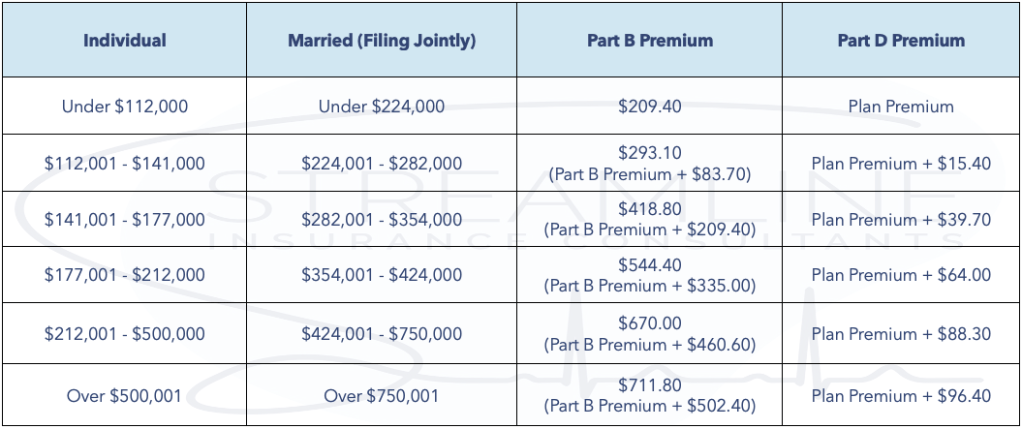
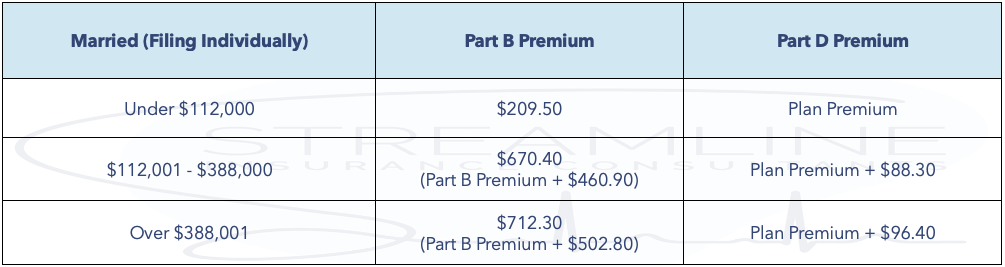
Note: Individuals who are married but file a separate tax return and lived with their spouse at any time during the tax year face specialized, significantly lower threshold brackets.
The Part D Layer: Prescription Drug Surcharges
IRMAA is a double-edged sword. If you trigger a Part B surcharge, you will also owe an IRMAA surcharge on your Part D prescription plan (or the Part D portion of a Medicare Advantage plan).
For 2027, the Part D IRMAA surcharges stack on top of your plan’s base premium as follows:
- Tier 1: +$15.40 / month
- Tier 2: +$38.70 / month
- Tier 3: +$62.00 / month
- Tier 4: +$85.20 / month
- Tier 5: +$96.40 / month
At the highest tier, a beneficiary will pay an extra $598.80 per month ($502.40 for Part B + $96.40 for Part D) in surcharges alone, bringing their total monthly Medicare premium layout well over $700.
The “Cliff” Danger and How to Fight It
Unlike progressive income tax brackets where only the money over the threshold is taxed at a higher rate, IRMAA operates on a strict cliff model. Going just $1 over a threshold pushes your entire monthly premium into the next tier for the whole year. For instance, a single filer with a 2025 MAGI of $112,001 will pay an extra $1,004.40 over the course of 2027 compared to someone who made $112,000.
What if your income has since dropped?
If your income in 2026 or 2027 is significantly lower than it was in 2025, you do not automatically have to accept the IRMAA surcharge. The Social Security Administration allows you to appeal an IRMAA determination if you experienced a qualifying Life-Changing Event (LCE).
Recognized life-changing events include:
- Retirement or work stoppage
- Work reduction (cutting back hours)
- Marriage, divorce, or annulment
- Death of a spouse
- Loss of income-producing property (due to a disaster or natural event)
- Loss or reduction of a pension
To request a reduction, you must fill out Form SSA-44 (Medicare Income-Related Monthly Adjustment Amount – Life-Changing Event) and provide documentation verifying both the event (such as a letter from an employer) and your new, lower estimated income.
Final Takeaway
With the 2027 IRMAA numbers set in stone, beneficiaries have a clear picture of their upcoming healthcare costs. If you are approaching retirement or expect a sudden spike in income—such as from a home sale, Roth IRA conversion, or large RMD—proactive tax planning remains the most effective defense against future IRMAA cliffs. If you have questions about IRMAA or how your income may affect your part B premium fill out the contact us form to get in touch with one of our qualified Streamline Agents, or reach out to your local agent for more information.


Leave a Reply